
Lyon County Recent Arrests
Lyon County posts no browser roster with a search box and a live results table. The official LCSO Inmate Search page instead points the public to the sheriff's mobile app. It also points to Nevada's custody-notification service. That matters when you are tracking a new arrest. A booking may still be processing. It may be held for another agency. Or it may drop out of a current-custody view after release. None of those states tells you the final court result.
Different windows answer different questions. The 24 Hour Arrests page walks through the same-day route and its limits. The Arrest Log page explains the recurring multi-day newspaper blotter and older reports. Neither replaces an official custody confirmation.
| Window | Best source | Key limit |
|---|---|---|
| Same day | LCSO app, jail, then SAVE | No separate official browser feed was verified |
| Several days | Fernley Reporter arrest reports | News snapshots may lag and are not live custody records |
| Current custody | LCSO app and SAVE | Absence does not prove no arrest |
| Older booking | LCSO records request | Requires a specific request and may involve fees |
Arrested Last Night in Lyon
Someone arrested last night may not show up right away. Intake covers identity checks, property processing, charge entry, medical screening, and release decisions. Start at the official inmate-search gateway and its app. Unclear result? Call the Lyon County Detention Facility at 775-463-6600. For ongoing status and alerts, use Nevada SAVE. The VINELink Check explanation covers the state's transition. A name missing from one screen can mean release, delay, or transfer. It can also mean a spelling mismatch or a different custody system. That gap is not proof that no arrest happened.
The official LCSO inmate-search landing page shows where the county currently routes online users.
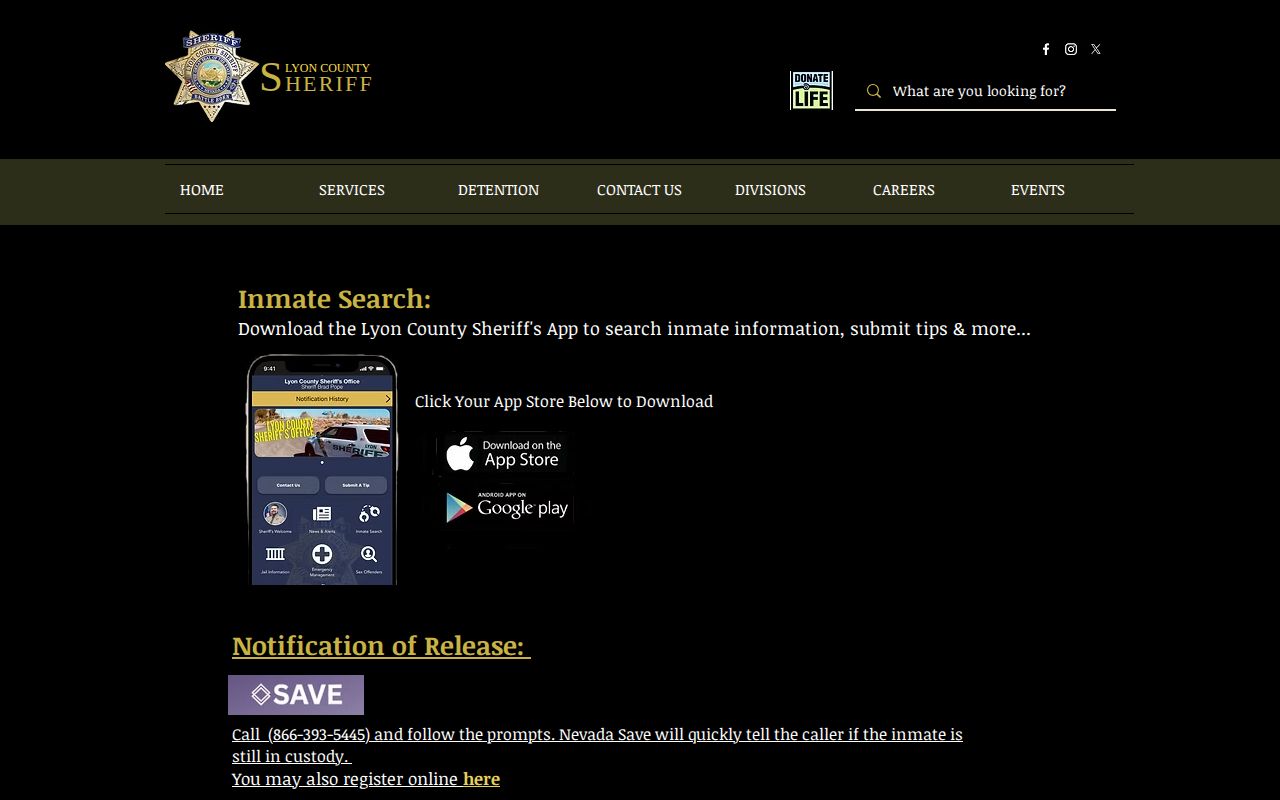
The page documents the gateway itself, not a gallery or any person's custody status.
Lyon County Jail Roster
The county's roster path is app-first. The sheriff's app is advertised with inmate search plus agency news, alerts, tips, emergency information, a directory, and other public-safety tools. The app's current search fields, photo display, refresh rate, and record persistence are not documented. Those unknowns stay unknown. The browser page promises no photo, and local reporting says LCSO stopped its former online mugshot posts in September 2024.
Use the roster in a short chain:
- Open the official LCSO inmate-search page and follow its app link.
- Search with the identifying details the current app requests, without assuming unverified fields.
- Confirm a match with the detention facility when identity or timing is uncertain.
- Use SAVE for status alerts, not as a mugshot or court database.
- Request an existing booking record or photo from LCSO Records when the current view is not enough.
| Possible field | Verified location | Caution |
|---|---|---|
| Name and custody status | Official app route and SAVE | Current app layout was not verified |
| Booking date, agency, charges, bail | Local reports and secondary listings | Confirm through LCSO |
| Booking photo | LCSO records-request route | Do not assume it appears online |
| Disposition | Correct court | Not a jail-roster field |
Lyon Arrest Search Uses an App
Fernley's city site says the official sheriff app launched in 2023 for iOS and Android. The listings call it "Lyon CSO View." Its tool set goes beyond a basic inmate roster. Still, it is not an emergency channel. Call 911 in an emergency, and use non-emergency dispatch at 775-463-6620 for other immediate needs. App-store details and update dates shift. Check the official Fernley app page, the Apple listing, and the Google Play listing before counting on any feature.
The official app information page illustrates the county's mobile-first access route.
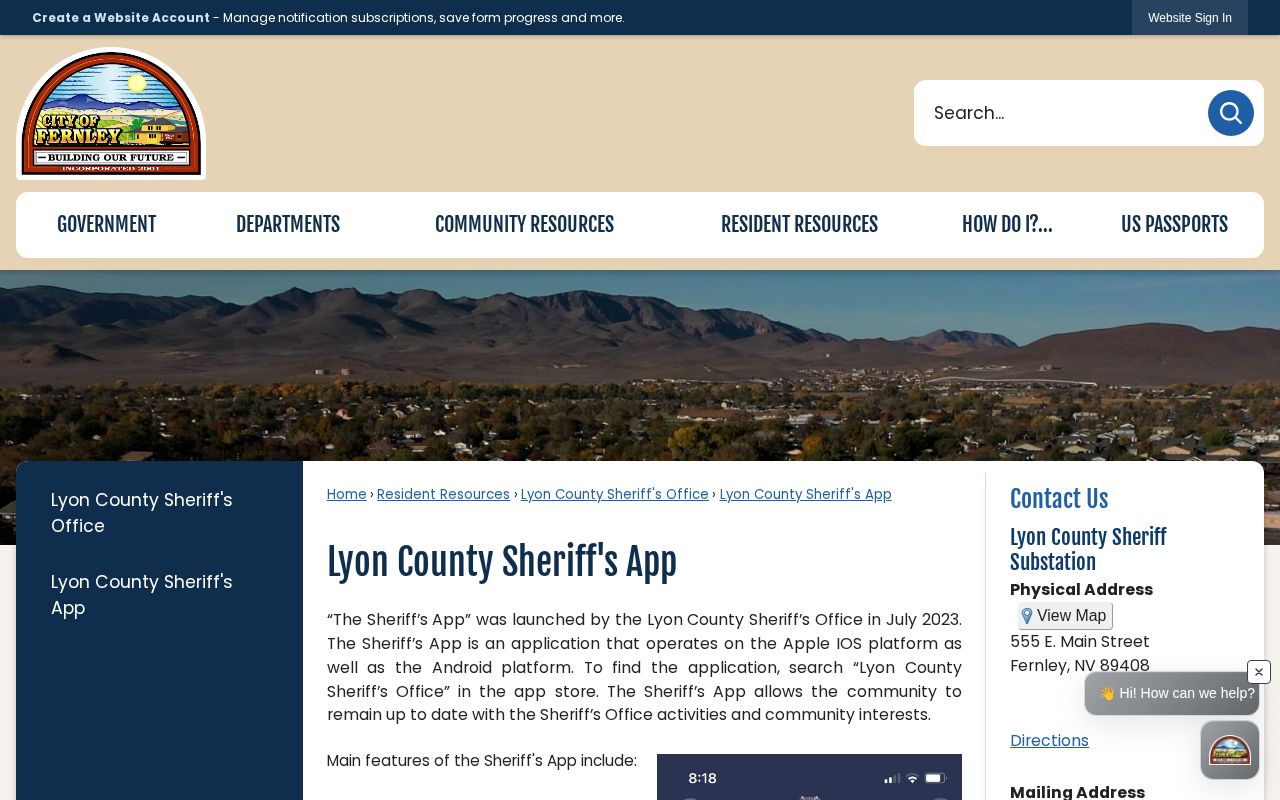
Start with the app for a Lyon County arrest search, and turn to LCSO Records for copies of existing records.
Lyon County Booking Sources
Official sources come first because they control custody and records. News reports and aggregators can offer a lead. They can also lag, skip a release, use their own identifiers, or keep old material after the source changes. A third-party timestamp is not LCSO's update promise.
| Channel | Official? | What it can answer |
|---|---|---|
| LCSO app and jail | Yes | Current county custody and direct confirmation |
| Nevada SAVE | Yes | Custody or supervision status and alerts |
| LCSO Records | Yes | Existing booking information, reports, and requested photos subject to law |
| Fernley Reporter | No, local news | Recurring date-range arrest reports sourced to LCSO |
| Busted Newspaper and RecentlyBooked | No | County-local secondary indexes that require official confirmation |
The Fernley Reporter sample arrest report displays the paper's area, bail, charge, and source details.
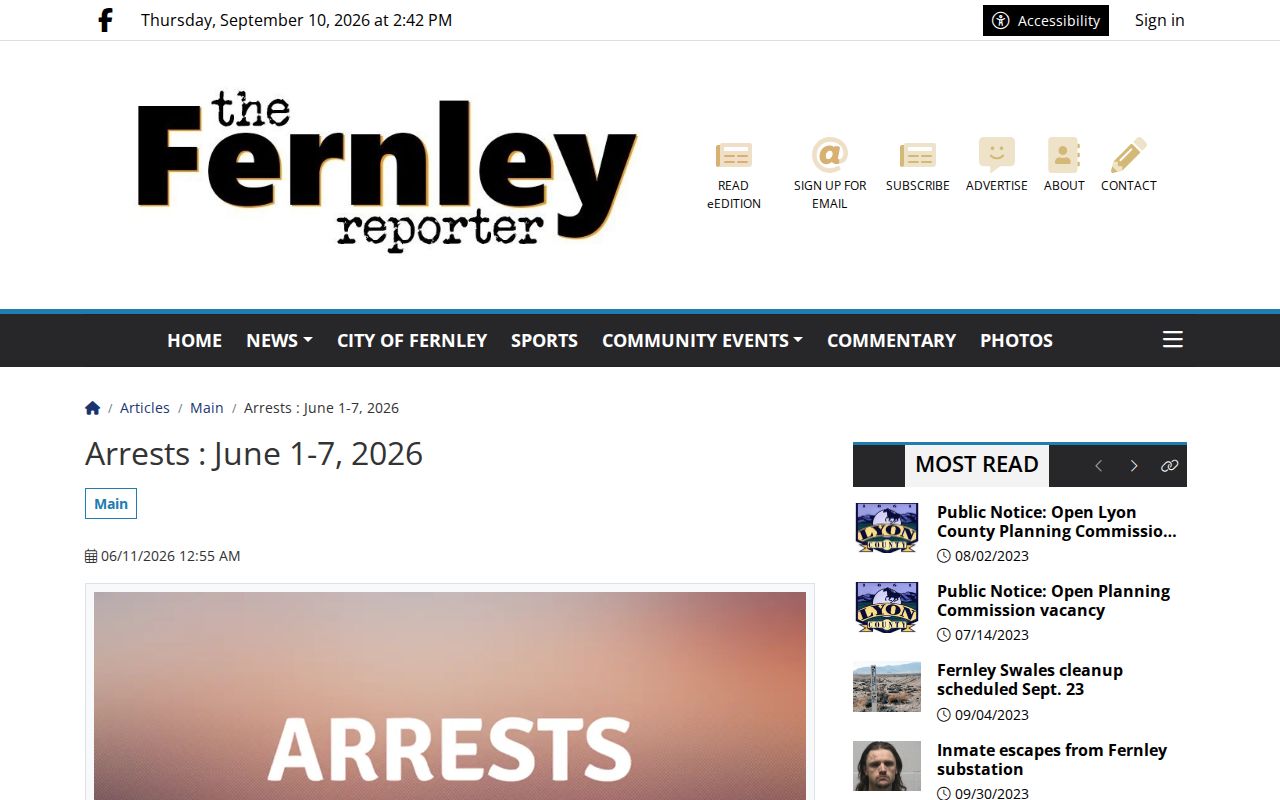
That report is a dated news snapshot, not a live jail screen.
Busted Newspaper and RecentlyBooked are the only major aggregators with confirmed Lyon County sections. Their entries can carry names, dates, agencies, charge labels, bond details, descriptors, and photos. All of it comes from the publishers' own presentations. Mugshots.com, Arrests.org, and Mugshots.zone list no confirmed Lyon-specific coverage. They should not be treated as county sources. CountyInmateSearch and JailExchange are secondary directories too. When an outside page conflicts with LCSO, SAVE, or a court, the official custodian controls. A news story can also stay online long after a person leaves jail. Its presence says nothing certain about current custody.
Lyon Recent Arrests by City
Lyon County has two incorporated cities. Fernley Recent Arrests follows a sheriff-policed city: LCSO provides city law enforcement, and the Fernley substation sits apart from the detention facility in Yerington. Yerington Recent Arrests covers a city with its own police department, while county detention remains the booking destination for agencies using that facility. Dayton, Silver Springs, and other communities count as service areas, but the official municipal map gives them no incorporated-city pages.
Keep agency and area labels separate. The arresting agency may hold the incident report. The jail holds the booking record. The proper court holds the disposition. One event can therefore require three separate contacts.
Lyon County Arrest Record Fields
Every Lyon County booking entry starts at intake. It becomes an arrest record on the spot. The typical entry covers the arrestee's name, booking date or time, booking or report number, arresting agency, reported area, charges as booked, bail or bond, custody status, and physical descriptors. Some Lyon entries add a photograph. The current app does not display every field. A court date, plea, dismissal, sentence, or acquittal is court material. Ask the court for those details rather than the jail entry.
- Booking
- The jail intake process and resulting custody record.
- Bond
- A court-set release condition or amount, not a fine or finding of guilt.
- Disposition
- The court's later outcome, such as dismissal, plea, acquittal, or judgment.
- Detainer
- A request or legal hold from another authority that may affect release.
Lyon Arrest Photos After 2024
Booking photos were once routine on LCSO social posts. Local reporting even described a weekly Sunday-to-Sunday "Mugshot Monday" series. The Fernley Reporter policy account says that ended in September 2024. LCSO stopped posting mugshots online. The move followed legal advice tied to Ninth Circuit litigation. That story is policy history, not a Nevada statute. The official photo path now runs through an LCSO records request. That page states photographs carry an added published fee. The official LCSO request interface documents the route for a report or a booking photograph.
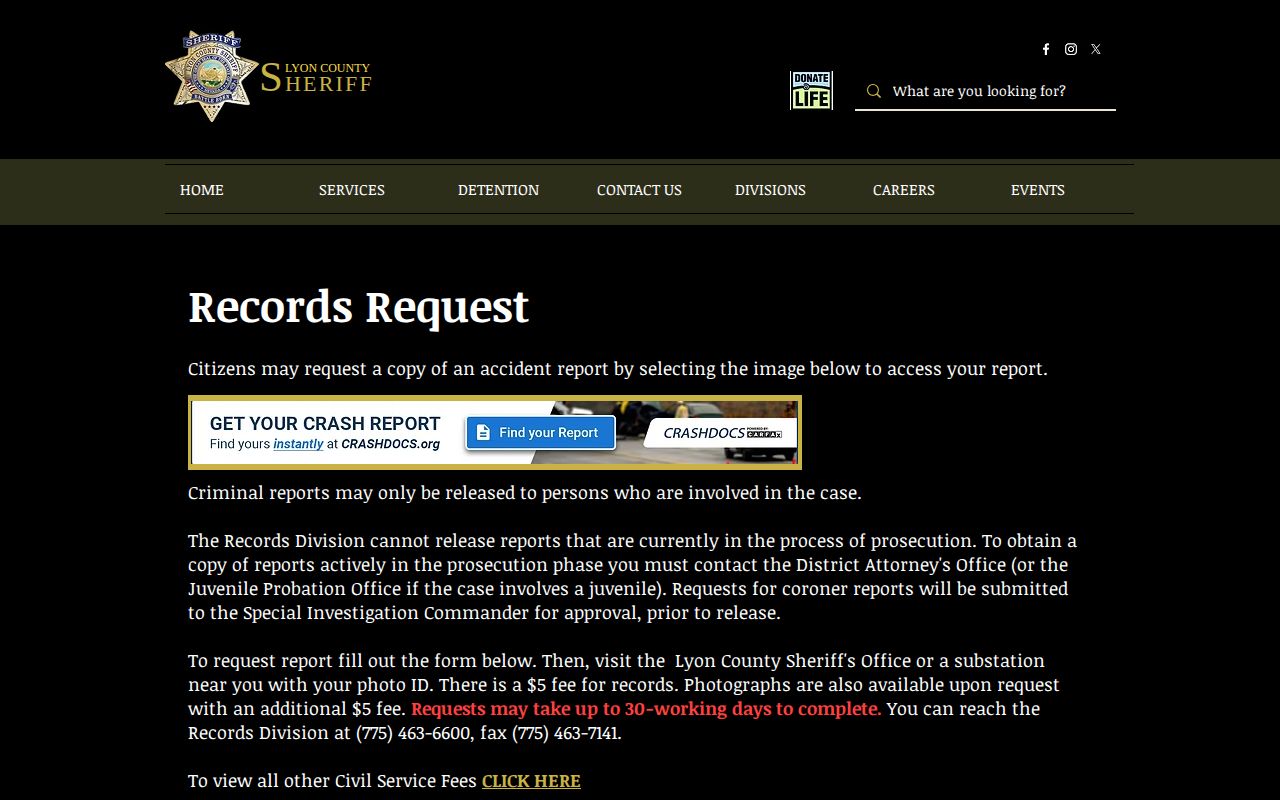
A booking photo remains an intake artifact in Lyon County. It is part of the jail's intake file.
Request a Lyon Booking Record
LCSO publishes two request routes with different price language. The report-specific Records Request page lists records at $5, photographs at $5 more, and completion within up to 30 working days. The separate Public Records Request page describes general NRS 239 requests at $45 per hour with a $45 minimum. Guessing between them costs money. Describe the record you need. Ask which form applies, and confirm the current charge before you pay.
- Identify the custodian. Ask the arresting agency for its incident report and LCSO for jail booking material.
- Give a name, approximate date, report or booking number if known, and the precise record sought.
- State whether the request includes a photograph and the preferred format or delivery method.
- Confirm the correct form, applicable fee, and current fax or submission route.
- Use the proper court for a final disposition that is not part of the booking file.
Active prosecution changes the picture. LCSO says those reports are not released through its Records Division and are routed elsewhere. Juvenile, victim, investigative, sealed, and other protected material can also be withheld or redacted. A request seeks an existing Lyon County record. No agency must build a new report.
Nevada Records Law and Removal
Nevada's public-records framework comes from NRS Chapter 239. NRS Chapter 179 and NRS Chapter 179A cover sealing and criminal-history records. No Nevada statute creates a mandatory county mugshot feed. No Florida-style ban on paid removal exists either. Access depends on the actual record, its custodian, exemptions, court orders, and LCSO policy.
Start any correction with the agency or court that controls the record. Nevada's RCCD sealing information explains the state process. If an official source changes, request a free correction from the publisher that copied it. Busted Newspaper and RecentlyBooked publish free policy routes for errors, dismissals, sealing, and wrong-person issues. Those policies guarantee nothing and are not Nevada law. Once the source page changes, Google's free outdated-content refresh can update a stale listing. Never pay anyone who promises guaranteed erasure.
How Long Lyon Records Remain
LCSO publishes no fixed schedule for how long a booking photo stays online. One request page shows a 30-working-day figure. That number is a response estimate, not a retention term. Nevada's local records framework allows schedules by record series, longer retention, legal holds, and archival review. Ask LCSO Records about an older booking. Request the booking, jail, report, photograph, or electronic-record series and its adopted schedule. Historical newspapers are a separate archive. They do not establish current custody. Sealed records and stale web copies differ. A sealing order reaches the legal process and named custodians, while a third-party page needs its own correction route, and a search refresh only updates the listing after the source changes.
Lyon Warrants and Wanted Posts
LCSO runs a documented Warrant Wednesday practice. Annual reports and local news show wanted posters carrying descriptors and bail information. The department posts no permanent searchable county warrant database. No complete most-wanted archive exists either. Social and news posts are snapshots, so treat them that way. A possible warrant deserves the official route. Contact the court clerk, a Nevada attorney, or LCSO. Never let an old image or an aggregator decide that a Lyon County warrant is active.
Never approach anyone shown in a wanted notice. Emergencies belong at 911, and non-emergency tips can go to dispatch at 775-463-6620 or the LCSO tip form. The form takes optional contact details, but it is not a warrant-clearance service and never a source of evasion advice.
After a Lyon County Arrest
What happens after a Lyon County arrest unfolds in stages. Booking comes first. Then the jail takes custody, and a photo may be taken. Arraignment follows, where the court takes up the charges and any conditions of release. Which court handles the case turns on two things. One is where the arrest happened. The other is the nature of the charge. A Lyon County matter might land in Fernley, Dayton, or Walker River Justice Court. A municipal court or the Third Judicial District Court can also take the case. The Nevada Judiciary court finder helps point you to the right office. For records themselves, Lyon County eFlex handles electronic filing and retrieval. It needs an account, though. It is not an open countywide arrest search.
Booking path: Arrest → jail intake and possible photo → current custody check. Then comes arraignment and bond review, followed by court disposition. Possible sealing comes last where the law permits.
The final step can reshape the first. Charges may be declined, reduced, dismissed, or end in acquittal down the line.
Custody Beyond County Booking
A county jail booking and a state prison record are different things. The Nevada Department of Corrections search tracks people held in state prisons. It does not track county jail arrivals. You can query it by offender ID. First and last name work too. Wildcards are documented. NDOC also offers downloadable files covering demographics, aliases, booking events, parole, and release dates. Its notes warn that photos may not load without a supported browser. Raw data can contain errors. One more caution applies here. An NDOC photo shows a prison intake, not a fresh county booking photo.
Federal custody works through the Bureau of Prisons locator. It lists federal inmates back to 1982. The locator has no booking-photo gallery. ICE runs its own separate locator, and it only helps when the facts point to ICE or certain recent CBP custody. A Lyon County search that comes up empty does not mean someone landed in state, federal, or immigration custody. Guessing helps nobody. Follow what you actually know about the arresting agency, any transfer, the court, or supervision.
NDOC provides one more route for records outside the locator. Its fee page says written inspection requests are handled within five business days. The page lists charges for paper copies. It also sets rules for electronic media or unusual requests. That process serves state corrections records only. It does not replace LCSO's forms for a county booking. Neither agency can create a record it simply does not hold.